AI 挖因子,谁来当裁判 Let the agent propose; let the referee judge
2026 年 9 月,三篇论文从三个角度撞上同一件事:提议可以交给 AI,裁判必须留在外面。我把主论文的机制做了一遍简化复现——边看边停的裁判,每 1,000 个提案会错误放行约 205 个;冻结裁判只有 39 个,代价是等待时间。 Three papers published within one week of each other in September 2026 point at the same division of labour: let the agent propose, keep the judge outside. In my replication a peeking referee wrongfully admits about 205 of every 1,000 proposals; a frozen one admits 39 — at the price of waiting.
TL;DR
- AI 已经接管了因子研究的全流程:提因子、回测、筛选、淘汰。主论文问的是——这些工作里,哪一件应该收回来?答案是判断。 Agents now run the whole factor research loop. The paper asks which of those jobs should be taken back: the answer is judging.
- 机制是"冻结裁判":裁判只看提交之后才出现的市场结果,用投注式证据(e-value)逐月累计,因此任何时刻停止都有效——"边看边停"不再能作弊。[1] The mechanism is a frozen referee scoring only on post-submission outcomes, accumulating betting evidence, valid at any stopping time.[1]
- 我的复现:差距是 5.2 倍。每 1,000 个提案,边看边停的裁判错误放行 205 个,冻结裁判 39 个,先切一半数据再确认的 2 个——而三者拿到的真因子分别是 99%、67%、51%。 My replication: 205 vs 39 vs 2 wrongful admissions per 1,000 proposals — while capturing 99%, 67% and 51% of the true factors.
- 认证的价格是时间。真因子年化夏普 1.0 时,冻结裁判平均要等 58 个月;夏普 2.0 时降到 22 个月(约 480 个交易日,与论文说的"约 500 个交易日"同一量级)。先切一半数据的做法则固定要等满十年。 Certification costs time: 58 months at Sharpe 1.0, 22 months at 2.0 — the same order of magnitude as the paper's ~500 trading days. The split-sample rule always waits the full decade.
- 另两篇是配套的警告。同一段文本,七个模型给出的指标排序相关平均只有 0.52;而"让 agent 自我进化"在 18 条长周期轨迹里没有一致增益。AI 会更强,但"更强"目前还没有稳定兑现——这更说明裁判要留在外面。[2][3] Two companion warnings: across seven models, textual measures rank-correlate at only 0.52 on average; and self-evolving agents showed no consistent gain across 18 long-horizon trajectories.[2][3]
本文有两类材料,我会分开标注:① 论文事实——三篇 2026 年 9 月的 arXiv 预印本,链接在最后一节,均于 2026-09-29 核对可打开;② 我的复现——我自己的合成世界(月度收益、独立同分布、单一波动),实现了一个简化版的投注式裁判,不是论文的原始代码(论文未附公开代码)。因此本文的绝对数字只能读作"同一量级的示意",不能读作论文结论的独立验证。 Two kinds of material, labelled separately: paper facts (three September 2026 arXiv preprints, links checked on 2026-09-29) and my own replication in a synthetic world, using a simplified betting-based referee rather than the authors' code, which is not public. Read my numbers as the same order of magnitude, not as independent confirmation.
01为什么写这篇Why this note exists
上个月我用一篇文章讲过因子筛选的困境:候选太多、样本太少,按 t 值排名挑出来的东西,样本外大多是噪声。[4] 那篇的结论是"筛选的天花板由信噪比决定"。但它留了一个没说透的问题:如果挖掘这件事本身被自动化了,会发生什么? A previous note argued that factor screening is capped by signal-to-noise: rank by t-statistic and most survivors are noise out of sample. It left one question open — what happens when the mining itself is automated?[4]
2026 年 9 月这一周给出了答案,而且是从三个不同方向来的:一篇讲谁来判断,一篇讲连测量都不稳定,一篇讲自我进化没有稳定收益。三篇合起来是一句对做研究的人很重要的话——AI 让"想法"变便宜了,于是稀缺的东西变成了"裁判"。 The last week of September 2026 answered it from three directions: who judges, why even measurement is unstable, and why self-evolution has not delivered. Together: AI made ideas cheap, so the scarce thing is now the referee.
02主论文:提议权与判断权的分离The main paper: separating proposing from judging
《Propose, Don't Judge》的开场是一句很直白的话:语言模型 agent 现在已经跑完了整个量化因子研究流程——提出因子、回测、选出幸存者、淘汰其余的。[1] 作者问:这些工作里,哪一件应该收回来? "Propose, Don't Judge" opens plainly: language-model agents now run the entire quantitative factor pipeline — proposing, backtesting, selecting survivors, retiring the rest. The authors ask which of those jobs should be taken back.[1]
他们的答案是"受约束的自我进化":agent 可以提议,但必须由一个它不能触碰的冻结裁判来判定。裁判只根据提交之后才出现的市场结果打分,方式是"投注"——每来一期数据就押一次,把证据累加成一个非负的过程。这样的检验在任何停止时刻都有效,也就是说:agent 再怎么"看一次就停",统计保证都不会被破坏。 Their answer is governed self-evolution: the agent may propose, but a frozen referee it cannot touch decides. The referee scores only on outcomes revealed after submission, betting each period and accumulating a non-negative process — valid at every stopping time, so peek-and-stop no longer breaks the guarantee.
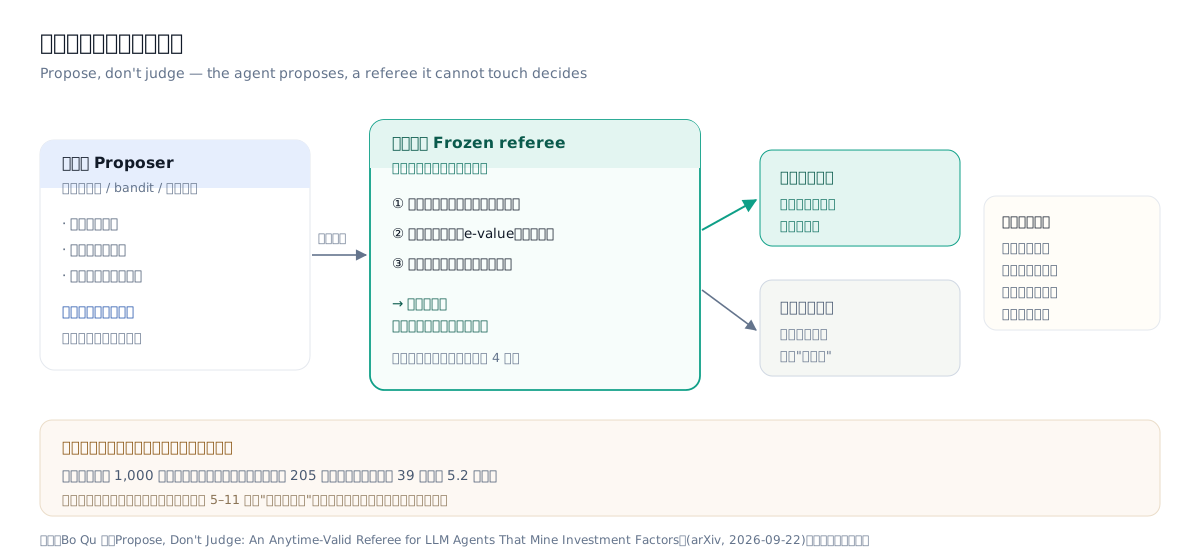
论文的实验设计也值得抄一遍:三个提案者(脚本、bandit、语言模型)× 一个冻结裁判 + 三个"故意漏水"的裁判,先在一个种了真值的合成世界里比,再放到 CSI 500 上做十年走查。结果有两条: The experiment design is worth copying: three proposers (a script, a bandit, a language model) crossed with the frozen referee and three deliberately leaky ones — first in a synthetic world with planted truth, then a ten-year walk-forward on the CSI 500.
- 谁当裁判,决定放行多少噪声:冻结裁判比漏水的裁判少放行 5–11 倍的"不达标因子",而且没有任何提案者能补上这个差距。 Who judges sets the noise admitted: the frozen referee lets through 5–11× fewer sub-threshold factors, and no proposer closes that gap.
- 谁提议,决定产出多少:语言模型胜过脚本、与 bandit 持平,并且多出一样 bandit 没有的能力——给自己写诊断工具。 Who proposes sets the yield: the language model beats the script, matches the bandit, and adds one capability a bandit lacks — writing its own diagnostic probes.
论文自己给了三个价格:① 被认证的真因子平均要等约 500 个交易日;② 被认证组合的夏普落后于没有门槛的版本;③ 裁判的结论不受提案者策略影响——"判断属于流程,提议与造工具属于 agent"。[1] The paper names three prices: an admitted true factor waits about 500 trading days; the certified portfolio's Sharpe trails the ungated one; and the verdict does not depend on the proposal policy. Judging belongs to the procedure; proposing and instrument-making belong to the agent.[1]
03我的复现:三个裁判,三张成绩单My replication: three referees, three scorecards
论文没有公开代码,所以我用自己的方式把机制跑了一遍。世界很简单,但足够说明问题:一个提案者连续提出候选因子,其中 20% 是真的(年化夏普 1.0),其余是纯噪声;每个候选有 10 年月度数据,三种裁判独立判断。 The paper ships no code, so I rebuilt the mechanism my own way. The world is simple but sufficient: an agent proposes candidates one at a time, 20% carry real alpha (annualised Sharpe 1.0) and the rest are pure noise; each candidate has ten years of monthly data and three referees judge independently.
- 边看边停:每个月做一次检验,看到单尾显著就宣布(现实里最常见的做法)。 Peeking: test every month and declare as soon as the one-sided test is significant — the most common practice in the wild.
- 先切一半:前五年筛选、后五年确认,两段都过才宣布。 Split and confirm: screen on the first five years, confirm on the next five.
- 冻结裁判:投注式证据逐月累计,达到 1/α 才宣布(我的简化版 e-process)。 Frozen referee: accumulate betting evidence monthly and declare at 1/α — my simplified e-process.
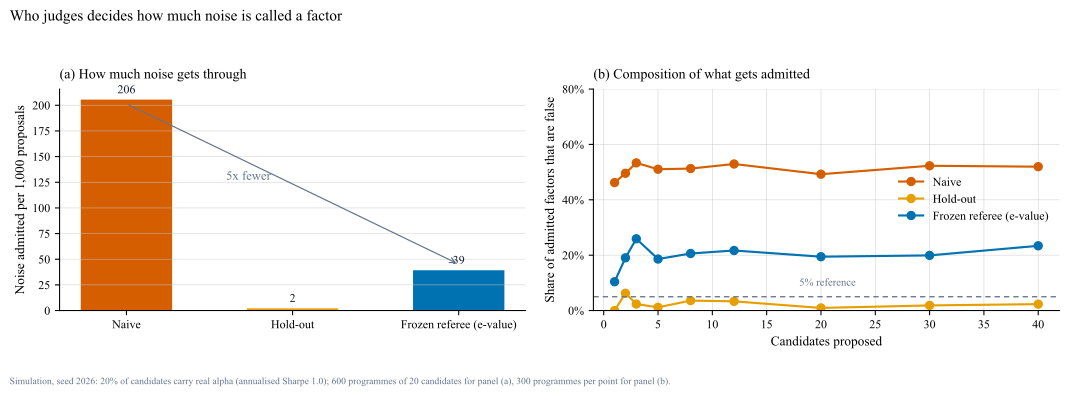
tools/make_figs_referee.py,固定种子)。
左边是本文最重要的一个数字:每 1,000 个提案,边看边停错误放行 205 个,冻结裁判 39 个——5.2 倍,正好落在论文报告的 5–11 倍区间里。右边解释为什么:边看边停对"噪声"和"真信号"一样敏感,所以它放行出来的东西里约有一半是噪声;而先切一半的做法几乎不放噪声,代价见下一张图。
The headline number: 205 wrongful admissions per 1,000 proposals for the peeking referee versus 39 for the frozen one — a factor of 5.2, inside the paper's 5–11× range. The right panel explains why: peeking reacts to noise as readily as to truth.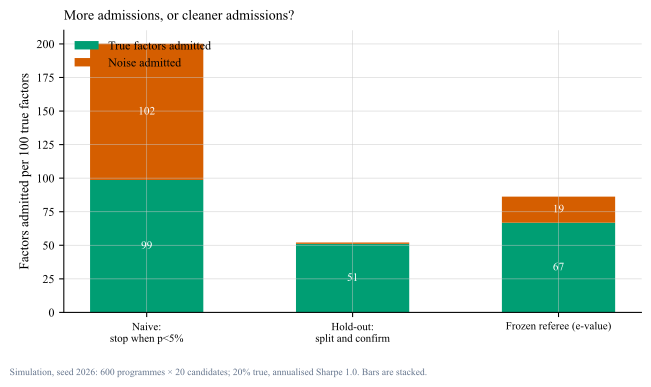
04认证的价格是时间The price of certification is time
冻结裁判不是免费的午餐。它要求"提交之后的数据",而攒证据需要时间——效应越弱,等得越久。这和我在因子筛选那篇里算过的"164 年"是同一件事的两个侧面:统计上没把握,就只能用时间去换。 The frozen referee is not free: it needs post-submission data, and evidence takes time. The weaker the effect, the longer the wait — the same physics as the 164 years computed in the screening note.
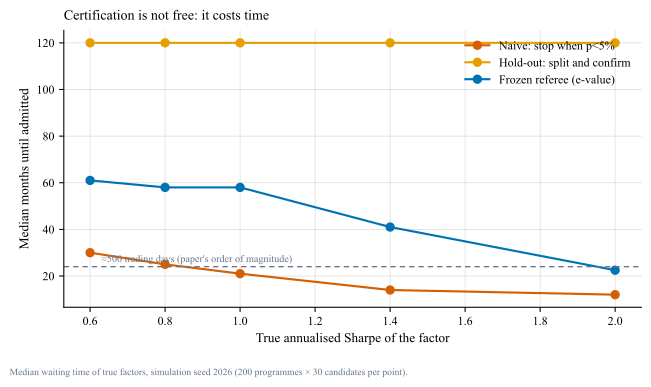
| 裁判Referee | 每千提案错误放行Noise per 1,000 | 真因子放行率True admitted | 放行物中噪声占比Noise share of admissions | 等待时间(夏普 1.0)Wait (Sharpe 1.0) |
|---|---|---|---|---|
| 边看边停Peeking | 205 | 99% | 约一半 | 21 个月 |
| 冻结裁判Frozen referee | 39 | 67% | 23% | 58 个月 |
| 先切一半Split and confirm | 2 | 51% | 2% | 固定 120 个月 |
注:三者不是"好/坏"排序,而是三种不同的取舍。真正的问题是"谁在决定什么时候停",而不是"门槛设多高"。 Note: three different trade-offs, not a ranking. The real question is who decides when to stop, not how high the bar is.
05第二篇:同一段文本,七个模型七个数字Paper two: same text, seven models, seven numbers
如果 AI 连"把文字变成数字"这一步都不稳定,那么再好的裁判也救不了上游。[2] 这篇论文拿了标普 500 公司的电话会议记录,用 7 个不同厂商的大模型、13 个常用指标(情绪、管理层清晰度、不确定性、气候与政治风险等)各打一遍分,然后看结果有多一致。 If AI cannot even turn text into numbers reliably, no referee can save the upstream.[2] The authors scored S&P 500 earnings-call transcripts with seven models from different providers across thirteen measures.
- 跨模型排序相关平均只有 0.52——同一段文本,"谁更清晰""谁的风险更高"这样的排序,换一个模型就换一半。 Cross-model rank correlation averages 0.52 — swap the model and half the ranking changes.
- 分歧不是"文本本身有歧义":与厂商无关的共同成分只解释了 34% 的分数方差,其余是模型特有的部分;而且这种分歧并不能预测分析师或市场的后续分歧。 The disagreement is not ambiguity in the text: provider-common components explain only 34% of score variation, and the disagreement does not predict later analyst or market disagreement.
- 下游结论会跟着变:用不同模型生成的变量做回归,系数的大小、符号、显著性都会变。把多个模型平均能让排序更稳,但分数水平仍然取决于你选了哪几个模型。 Downstream inference follows: coefficient magnitudes, signs and significance shift across models. Averaging stabilises rankings, but levels still depend on which models are in the ensemble.
这条结论对"AI 因子"的杀伤力比很多人以为的大:如果变量的值取决于模型选择,那么基于它做的回测就不只是"策略风险",还带着"测量风险"。我的做法是把它写进流程——同一因子至少两个厂商的模型各跑一遍,只有都成立的结论才进入下一步。 This bites harder than it looks: if a variable's value depends on model choice, its backtest carries measurement risk, not just strategy risk. My rule: run at least two providers and only advance conclusions that hold under both.
06第三篇:自我进化没有稳定增益Paper three: self-evolution without consistent gain
第三篇最难写进宣传语,但它可能是最有用的一篇。[3] 它问的是:让 agent 在长周期因子挖掘里"积累能力"(把研究反馈沉淀成可复用的技能、工具、规则),下一次会更好吗? The third paper is the hardest to turn into a slogan and possibly the most useful.[3] It asks whether accumulated research capabilities make the next round better.
- 18 条长周期轨迹里,"能力自进化"版本没有一致增益。 Across 18 long-horizon trajectories, capability evolution produced no consistent gain.
- 48 个续跑分支(同一个历史状态、同一个因子组合,只换能力集)里,积累的能力同样没有稳定胜出。 Across 48 continuation branches from the same state, accumulated capability did not consistently outperform either.
- 但调参仍然有用:对已有因子结构做参数微调,反而能改善组合——把旧东西调好,比幻想新能力更实在。 Yet parameter tuning of existing structures still improved the portfolio — improving what you have beats imagining new powers.
- 候选的价值取决于状态:有些当初被筛掉的候选,在原始状态下其实有正的边际价值;但把所有被筛掉的候选按顺序重新提交一遍,最终组合的 IC 反而略降。顺序与状态比"单个候选好不好"更重要。 Candidate value is state-dependent: some screened-out candidates had positive marginal value at the original state, yet resubmitting all of them sequentially slightly lowered final IC.
07三篇合起来:一张分工表Three papers, one division of labour
| 环节Stage | 交给谁Owner | 理由Why |
|---|---|---|
| 提候选、造工具Propose, build instruments | AI agent(可进化)The agent (evolvable) | 语言模型样本外产出最高,还能自己写诊断探针It yields most and writes its own probes |
| 判断(放行/淘汰)Judge: admit or retire | 冻结裁判(AI 不可触碰)A frozen referee outside the agent | 同样的提案者,换裁判就是 5–11 倍差距Same proposer, 5–11× difference by referee |
| 测量(文本→变量)Measurement: text to variables | 多模型交叉 + 明示不确定性Multiple models, stated uncertainty | 跨模型排序相关只有 0.52,单模型结论不可靠Cross-model rank correlation is only 0.52 |
| 留痕Record-keeping | 流程,而不是人The process, not a person | 提案总数是分母;没有分母的显著性没有意义The count of proposals is the denominator |
五条可以今天就用的规则
- 把裁判冻结起来:不同的代码库、不同的进程、不同的人复核;裁判的代码在研究期内不可修改。 Freeze the referee: separate codebase, separate process, separate reviewer; frozen for the duration of the study.
- 用"随时有效"的检验(e-value / 置信序列)替代"看到 p<0.05 就宣布"——本文模拟里这一个替换就带来 5 倍差距。 Use anytime-valid evidence (e-values, confidence sequences) instead of declaring on the first p<0.05.
- 记录提案总数,把它当作分母写进报告:研究会议上看的是"提了多少个、放行几个、其中几个是真的"。 Record the number of proposals and report it as the denominator.
- 把认证时间写进预期:如果一套流程承诺"两周出信号",它要么门槛很松,要么在偷偷边看边停。 Budget the certification time. A process promising signals within two weeks is either loose or peeking.
- 文本变量跨厂商验证,并把"模型选择"当成方法论的一部分披露,就像披露数据来源一样。 Cross-validate text variables across providers and disclose model choice like a data source.
08局限与反方观点Limits and the other side
- 我的世界是合成的。独立同分布的正态收益、单一波动、没有制度切换、没有成本、没有拥挤度。它能说明"机制",不能说明真实市场的量级。 My world is synthetic. I.i.d. Gaussian returns, single volatility, no regimes, no costs, no crowding. It shows a mechanism, not a market magnitude.
- 我的裁判是简化版。我用 normal-mixture e-process 代替论文的投注方案;绝对数字会不同(它们报告 5–11 倍,我得到 5.2 倍,属于同一量级)。论文没有公开代码,所以我无法逐行对齐。 My referee is a simplification. A normal-mixture e-process stands in for their betting scheme; absolute numbers differ (they report 5–11×, I get 5.2×).
- 三篇都是 2026 年 9 月的预印本,尚无第三方复现。我把"论文事实"与"我的复现"分开写,就是为了不让"新"变成"可信"的代名词。 All three are September 2026 preprints with no third-party replication yet — which is why the two layers of evidence are kept apart.
- 反方一:严格裁判会让你错过行情。确实。等 58 个月的信号可能错过一个完整周期——这就是"认证组合夏普落后"的意思。所以裁判要与资金的时间尺度匹配,而不是越严越好。 Objection one: strict referees cost you the move. Waiting 58 months can miss a cycle; certification must match the investor's horizon.
- 反方二:先验可以替代统计。如果候选来自明确的经济机制,门槛当然可以放宽——这不是反对统计纪律,而是说纪律与先验是两种不同的证据。 Objection two: priors can substitute for statistics. Candidates grounded in a clear mechanism justify a looser bar; discipline and priors are different kinds of evidence.
09我的判断My take
这三篇合起来,其实在描述一次"稀缺性的转移":过去研究里最贵的是想法,现在想法便宜了——贵的是"能证明一个想法不成立"的能力。谁的流程能诚实地淘汰东西,谁的研究速度才有意义;否则你只是在以更快的速度积累错误。 Together the papers describe a shift in scarcity: ideas used to be expensive; now the expensive thing is the ability to show an idea is wrong. A pipeline that can honestly retire things is what makes speed meaningful.
所以对我来说,操作含义只有一条:把"谁来判断"写进流程,而不是留给自觉——裁判冻结在提案者之外、提案数记在分母里、认证时间写进预期。这三件事不需要新模型,今天就能做。 The operational takeaway is one line: write "who judges" into the process instead of leaving it to good intentions — a frozen referee, a recorded denominator, and a budgeted certification time.
10来源(链接均于 2026-09-29 核查)Sources (links verified 2026-09-29)
- Bo Qu, Mingguang Chen, Licheng Wang (2026-09-22). Propose, Don't Judge: An Anytime-Valid Referee for LLM Agents That Mine Investment Factors. arXiv. arxiv.org/abs/2609.27051 (本文主论文;写作时未发现公开代码仓库)
- Hamid Boustanifar, Sasan Mansouri (2026-09-25). Same Text, Different Numbers: The Divergence of LLM-Based Measures. arXiv. arxiv.org/abs/2609.31013
- Siyuan Li, Jiangfeng Zhang, Rui Yao, Weihua Qiu, Mingyang Xu, Zixuan Yuan (2026-09-27). EverMine: Dissecting the Self-Evolution of Research Capabilities in Long-Horizon Alpha Research. arXiv. arxiv.org/abs/2609.33524
- Aylon (2026-09-25). 因子筛选:为什么样本内 1.95 的漂亮结果,样本外会归零. Notes. aayloo.github.io/notes/factor-screening/ (第 1 节提到的"上一篇",也是"164 年"那笔账的出处)
- 本文实验代码:
tools/make_figs_referee.py(固定种子 2026,可完全复现;模拟设定见开头的「口径」)。
11分享版摘要Shareable summary
12引用本文Cite this note
Aylon (2026). AI 挖因子,谁来当裁判. Notes, v1.0. https://aayloo.github.io/notes/ai-factor-referee/
13更新日志Changelog
| 版本Version | 日期Date | 改动Change |
|---|---|---|
| v1.0 | 2026-09-29 | 初版:三篇 2026 年 9 月论文 + 自建裁判模拟(四张图、五条来源,链接已核查)。 First version: three September 2026 papers plus my own referee simulation (four figures, five sources, links verified). |