Jev 与 System One Models:把 AI 变成代码里的一个判断 Jev and System One Models: turning AI into a decision inside your code
它不是「更聪明的分类器」,而是一类新的接口:非结构化状态进,带校准概率的类型化决策出。本文拆开它的定义、机制、与 LLM 的差别、能落地的位置,以及哪些话目前只能算官方口径。 Not a smarter classifier — a new interface: unstructured state in, typed decisions with calibrated probabilities out.
TL;DR
- Jev 是 TypeSafe AI 的 System One Model,2026-09-15 发布、早期访问。官方定位一句话:非结构化状态进,类型化概率决策出。[1] Jev is TypeSafe AI's System One Model, released 2026-09-15 in early access: unstructured state in, typed probabilistic decisions out.[1]
- 它不是分类算法。分类只是它能做的五种形状之一(分类、路由、打分、抽取、分支),真正的区别在于输出空间事前定义、每个答案带校准概率、且不生成字符串。[1] It is not a classification algorithm. Classification is one of five shapes; the real difference is a predefined output space, a calibrated probability on every answer, and no string generation.[1]
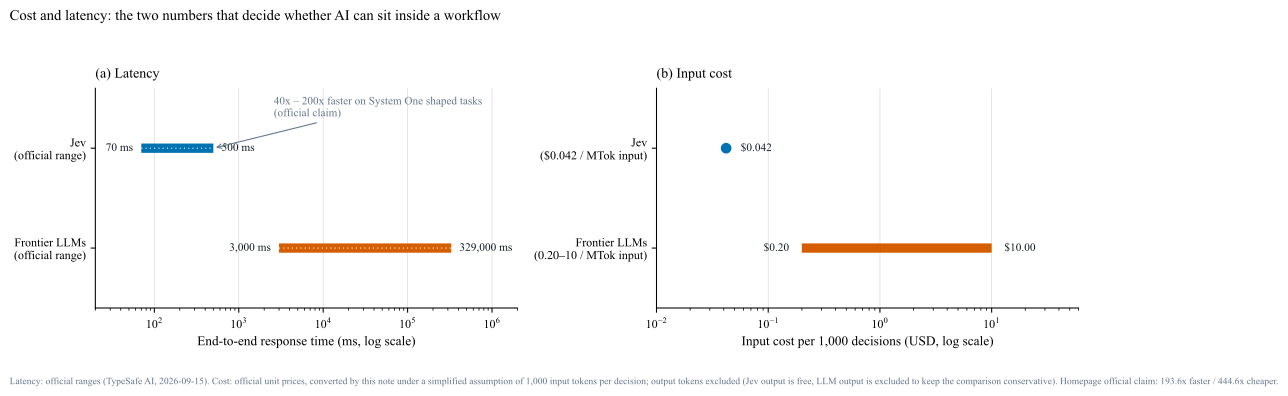
- 速度与价格的差异来自采样方式:一次查询并行产生全部输出,而不是逐 token 串行生成。官方口径 70–500 ms、输入 $0.042/MTok、输出不计费。[1] The speed and price difference comes from sampling: all outputs in one query instead of token-by-token. Vendor figures: 70–500 ms, $0.042/MTok input, output free.[1]
- 真正的卖点不是「更准」,而是能被代码依赖:知道自己在哪些个案上不确定,于是可以设阈值、可以让低置信度走人工、可以审计。[1] The selling point is not being more accurate but being dependable inside code: knowing where it is unsure, so thresholds, human review and audit become possible.[1]
- 本文所有性能与价格数字均是官方口径(官方自己也承认评测 workflow 由自家团队构造、参考答案偏向 OpenAI 与 Anthropic 的模型)。截至发稿我没有 early access key,没有实测。 Every performance and price number here is a vendor claim — the vendor itself notes the eval workflows were built by its own capability team and the reference answers favour OpenAI and Anthropic models. I had no access key, so nothing here is measured by me.[1][2]
全文只用两类原材料:TypeSafe AI 的官方发布文(2026-09-15)与官网首页,访问日期 2026-09-25。凡属官方说法,我都标成「官方口径」;凡属我的推导,用黄色卡片标成「推断」;凡属偏好与判断,用紫色卡片标成「观点」。官方口径 ≠ 已验证事实,这一点在第十节展开。 Two sources only: the vendor's launch post (2026-09-15) and its homepage, accessed 2026-09-25. Vendor statements are labelled as claims, derivations in amber, opinions in violet. A vendor claim is not a verified fact — see section 10.
01为什么写这篇Why this note exists
我在做文档识别与流程自动化的过程中反复遇到同一个卡点:规则的边界太清楚,模型的输出又太自由。 Working on document understanding and process automation, I kept hitting the same wall: hand-written rules are too brittle, while model output is too free-form.
用规则写「什么算 A 类单据」,遇到版式变化就失效;用 LLM 读,判断质量更好,但它返回一段文本,还是要解析、校验、处理它偶尔越界的情况——而且慢、贵、结果不稳定。中间那一格(判断带不确定性,但输出必须严格结构化)一直缺一个合适的接口。 Rules break when the layout changes. An LLM reads better, but returns text: it still has to be parsed and validated, it sometimes goes out of range, and it is slow, costly and inconsistent. The middle cell — a judgement that carries uncertainty but returns strictly structured output — had no good interface.
Jev 声称要填的就是这一格。这篇文章的目的不是替它背书,而是把「它到底提供什么、边界在哪、该怎么判断要不要用」讲清楚。 Jev claims to fill exactly that cell. This note is not an endorsement: it tries to pin down what it actually offers, where its boundaries are, and how to decide whether to use it.
阅读建议:第 2 到第 4 节是"是什么、不是什么、长什么样",可以当作概念梳理读;第 6 节(校准)与第 7 节(成本)是技术核心,决定它在真实流程里能不能用;第 10 节之后是我的判断与待验证清单。如果只读两节,读第 3 节和第 6 节——分别回答"别把它当成什么"和"凭什么信它的概率"。 How to read it: sections 2–4 cover what it is, what it is not and what a call looks like; sections 6 and 7 are the technical core — calibration and cost — that decide whether it survives contact with a real pipeline; sections 10 onwards are my view and open questions.
02它是什么What it is
官方定义(原文):Jev 是一个 System One Model——「a new class of frontier models built to make fast, structured decisions that software can use directly」,一句话版本是「a frontier-intelligence function call: unstructured state in, typed probabilistic decisions out」。[1] Official definition: Jev is a System One Model — "a new class of frontier models built to make fast, structured decisions that software can use directly", summarised as "a frontier-intelligence function call: unstructured state in, typed probabilistic decisions out".[1]
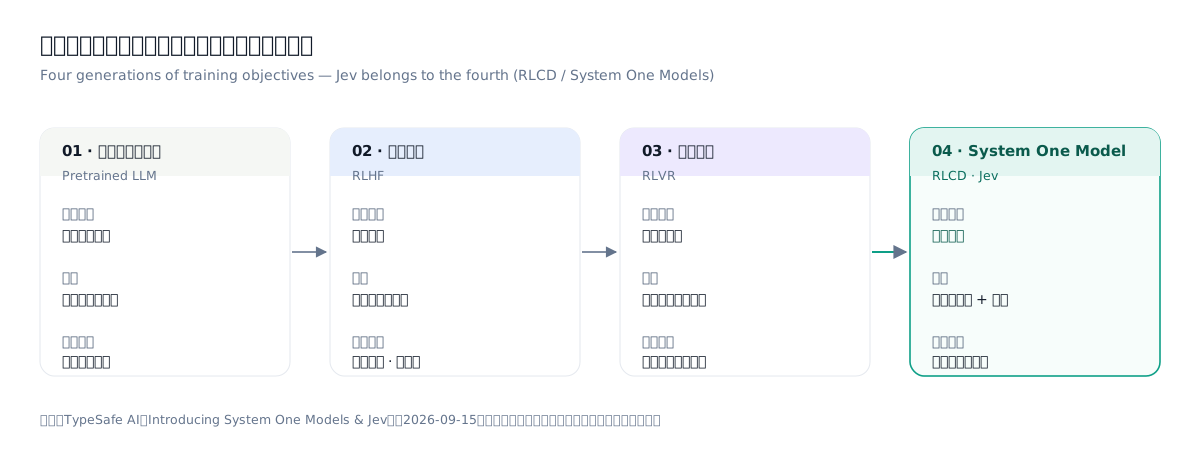
配套的技术主张有三条:新的模型架构、并行采样器(parallel sampler)、以及一套新的训练方法 RLCD(Reinforcement Learning for Calibrated Decisions,面向校准决策的强化学习)。官方把它的定位放在既有两代之后:RLHF 优化人类偏好产出对话模型,RLVR 用可验证奖励产出推理模型,RLCD 则直接以「带校准概率的决策」为训练目标。[1] Three technical claims accompany it: a new architecture, a parallel sampler, and a new training method, RLCD — Reinforcement Learning for Calibrated Decisions. The vendor places it after two earlier generations: RLHF optimised human preference into chat models, RLVR used verifiable rewards into reasoning models, and RLCD trains directly for calibrated decisions.[1]
压成三句话记住:① 输入是"状态"而不是"对话"——你给它一段程序状态,它不需要像聊天那样理解上下文;② 输出是"决策 + 概率"而不是"文字"——取值空间由你事先定义;③ 训练目标是"让概率值得信",而不是"让人类觉得回答得好"。这三点合起来,才是"接口"在这里的意思。 Three sentences to remember: the input is state rather than a conversation; the output is a decision plus a probability rather than text; the training target is that the probability deserves trust. Together, that is what "interface" means here.
03它不是什么What it is not
这一节比上一节重要。新产品发布时,误读通常发生在边界上。 This section matters more than the previous one: misreadings usually happen at the boundaries.
- 不是分类算法。分类是它的一种用法,但「逻辑回归 / 随机森林」意义上的分类器输出是标签,附加概率需要另行校准;Jev 的定义里,输出空间前置、概率校准、不生成字符串是三件事一起的。[1] Not a classification algorithm. Classification is one use. A logistic regression or random forest outputs a label and needs separate calibration; here, a predefined output space, calibrated probability and no string generation come as a package.[1]
- 不是聊天模型。官方明确说它放弃字符串生成,因此不适用于写文案、写代码、开放式问答、需要推理链的任务。拿它去聊天,等于放弃了它的全部优势。[1] Not a chat model. The vendor explicitly gives up string generation, so writing, coding, open-ended Q&A and chain-of-thought tasks are out. Using it for chat discards everything it is good at.[1]
- 不是你训练出来的自有模型。它是通过 API 调用的托管模型(早期访问);可以调阈值、可以定义输出空间,但「用你的数据重训一遍」不在当前描述内。[1] Not a model you train yourself. It is a hosted, API-accessed model in early access: you tune thresholds and define the output space, but retraining on your own data is not part of the current description.[1]
- 不是「万能判断器」。它做判断,不做检索、不算数、不查数据库;事实类输入仍然要由你的系统先准备好。 Not a universal oracle. It makes judgements; it does not retrieve, compute or query databases. Your system still has to prepare the facts.
「不生成字符串」看起来是能力上的退让,实际上是三个收益同时到手的交易:不做逐 token 的自回归 → 延迟与成本同时下降;输出空间有限 → 类型错误与幻觉的空间被压缩;概率内建 → 可以做阈值。三者是同一次设计取舍的三个侧面,而不是三种独立功能。 Giving up strings is not simply a sacrifice: it is one trade that yields three things at once — no autoregressive decoding (lower latency and cost), a finite output space (little room for type errors or hallucination), and a built-in probability (thresholds become possible). One design choice, three faces.
四个常见误解,逐个拆开
- "这不就是个分类器吗?"分类只是它的一种形状。真正的差别有三处:输出空间由你事先定义(不是模型自由发挥)、每个答案自带校准概率、以及不生成任何自由文本。把它当分类器用,等于放弃了后两项。 "Isn't this just a classifier?" Classification is one shape. The differences: you define the output space, every answer carries a calibrated probability, and no free text is generated.
- "不幻觉,所以可以全自动。"不幻觉不等于不出错。它不会编造取值之外的标签,但依然可能判断错——把 A 类判成 B 类,只是它会告诉你自己有多确定。能不能全自动,取决于错误代价,而不是概率好不好看。 "No hallucination means full automation." It can still judge wrongly; it just reports how confident it is. Full automation is a question of the cost of error.
- "便宜就能替代 LLM。"两者解决的是不同问题:LLM 负责写出来与开放式推理,决策层负责做判断并给出置信度。真实系统里通常是 LLM 处理文档与解释,决策层负责阈值与路由。 "Cheaper means it replaces LLMs." They solve different problems: LLMs write and reason openly; a decision layer judges and quantifies confidence. Real systems use both.
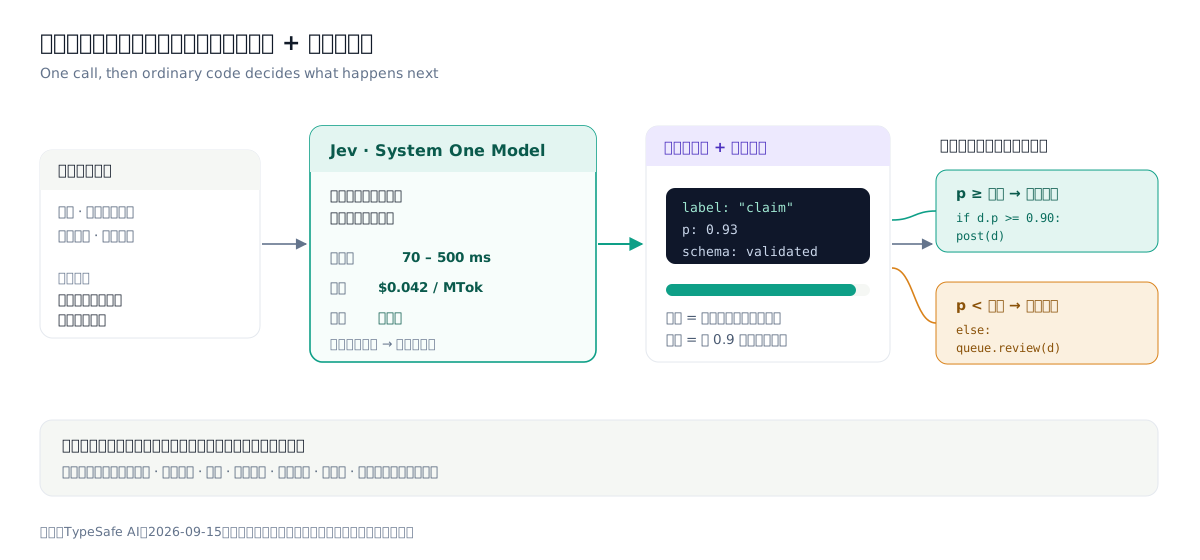
- "阈值设成 0.9 就安全了。"阈值不是安全参数,而是业务参数:调高会减少错误,同时把更多个案推给人工。要盯的是"复核率"与"漏检率"两条线的组合,而不是单一阈值。 "A 0.9 threshold makes it safe." It is a business parameter: raising it cuts errors and pushes cases to humans. Monitor the pair — review rate and miss rate.
04一次调用长什么样What one call looks like
把一次调用摊开,只有四步:把状态(文本、残缺字段、程序状态)交给模型 → 模型返回一组类型化的决策,每个都带概率 → 你在代码里设阈值决定谁自动执行 → 低置信度的走人工,并留下记录。 One call, four steps: hand over the state (text, partial fields, program state); the model returns typed decisions each carrying a probability; your code applies a threshold to decide what runs automatically; low-confidence cases go to a human, with a record kept.
05为什么快两个数量级Why it is two orders of magnitude faster
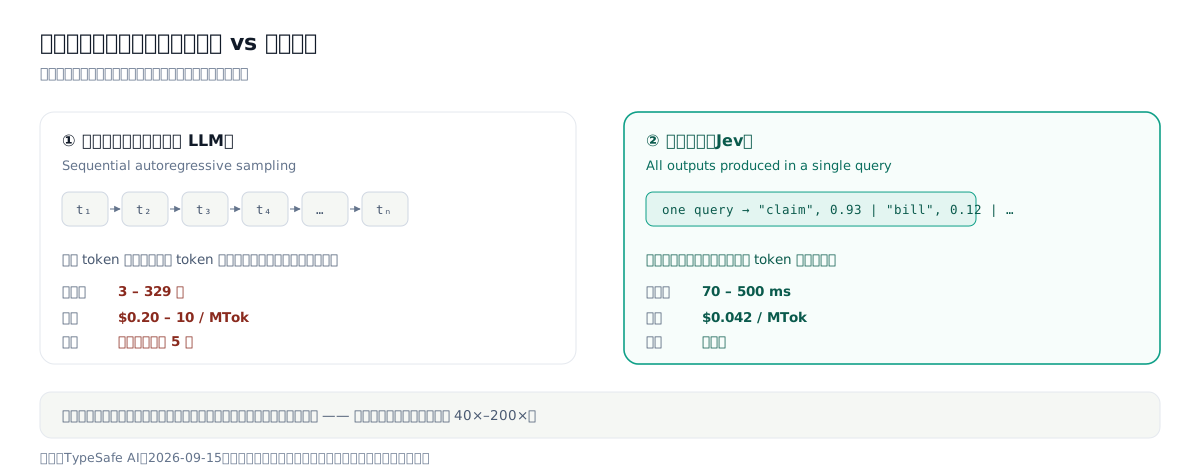
现有 LLM 是自回归的:一个 token 一个 token 地生成,每个都依赖前一个,时间和费用随输出长度线性累加。官方称 System One Models 用并行采样——在一次查询里同时产生全部输出,所以不随「输出个数」累积延迟。[1] Existing LLMs are autoregressive: one token at a time, each conditioned on the last, so time and cost accumulate with output length. System One Models instead use a parallel sampler: all outputs are produced within a single query, so latency does not accumulate with the number of outputs.[1]
06校准:为什么「有概率」比「更准」重要Calibration: why a probability beats accuracy
官方对这件事的表述很直接:如果一个模型有 95% 的情况下能做对,但从不说自己什么时候处在错的 5% 里,那么这个任务就没法被自动化。[1] The vendor puts it plainly: if a model does a task correctly 95% of the time but never signals which 5% it is wrong on, that task cannot be automated.[1]
「校准」的含义是:模型说 0.9 的那一批判断里,实际对的比例接近 90%。做不到这一点,概率只是一个数字,不能作为阈值依据。校准的常用检验工具是可靠性曲线——横轴是模型声称的置信度,纵轴是实际正确率,理想情况是 45° 对角线。 Calibration means: among judgements rated 0.9, roughly 90% are actually right. Without it, a probability is just a number and cannot carry a threshold. The standard check is a reliability diagram — claimed confidence on the x-axis, observed accuracy on the y-axis, the diagonal being perfect.
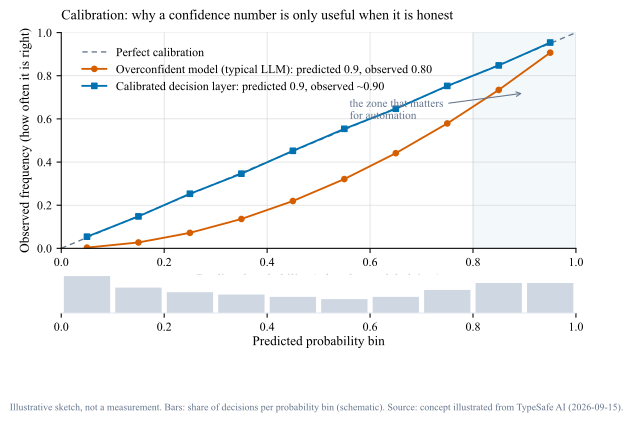
校准的价值随「错误代价」上升而上升。在可以方便人工复查的场景里,不校准只是多花人力;在延迟敏感、或者判断被埋在依赖链深处的场景里,不校准等于把不确定性当成确定性来用——这才是官方所说的「deal-breaker」。[1] Calibration matters more as the cost of error rises. Where a human can easily review, poor calibration merely costs labour; where latency matters or the decision sits deep in a dependency chain, treating uncertainty as certainty is the deal-breaker the vendor describes.[1]
07成本与延迟怎么算Cost and latency, and how to check them
官方价格口径:输入 $0.042 / MTok(即每十亿输入 token 42 美元),输出不计费;延迟 70–500 ms。对照的现有 LLM 区间是输入 $0.20–10 / MTok、输出约为输入价的 5 倍,端到端 3–329 秒。[1] Vendor pricing: $0.042 / MTok input (i.e. $42 per billion input tokens) with output free, at 70–500 ms. The comparison range for existing LLMs is $0.20–10 / MTok input, output about 5x the input price, and 3–329 s end to end.[1]
为了让这两组数字可比较,我做了最简单的换算:假设每次决策消耗 1,000 个输入 token,那么 1,000 次决策正好用掉 1 MTok,可以直接用单价读——LLM 是 $0.20–10.00,Jev 是 $0.042。这个换算剔除了输出 token(对 Jev 恰好是 0,对 LLM 是偏保守的算法),假设是本文的,不是官方的。 To make the two comparable I applied the simplest possible conversion: assume 1,000 input tokens per decision, so 1,000 decisions consume exactly 1 MTok and the unit price can be read directly — $0.20–10.00 for LLMs, $0.042 for Jev. Output tokens are excluded (exactly zero for Jev, and conservative for LLMs). The assumption is mine, not the vendor's.
08一个具体场景:单据分拣与路由A concrete case: document sorting and routing
下面这个流程纯粹是示意:我不引用任何真实业务数据,数字都是编的,只用来说明「决策层插在哪一步、阈值怎么起作用」。 The flow below is purely illustrative: no real business data, invented numbers, only there to show where a decision layer sits and how thresholds work.
设想一批版式不统一的单据:OCR 会带进噪声,字段有时缺、有时串行。传统做法是写一堆规则来判定类型与完整性;这里的做法是在规范化之后插一层决策:这属于哪一类(分类)、这个字段值能不能采信(打分)、缺的字段是不是必须退回补件(分支),每一项都带概率。 Take a pile of inconsistently formatted documents: OCR brings noise, fields are sometimes missing or misaligned. The conventional answer is a pile of rules. The alternative inserts a decision layer after normalisation: which category is this, is this field value trustworthy, and must it be sent back for more material — each with a probability.
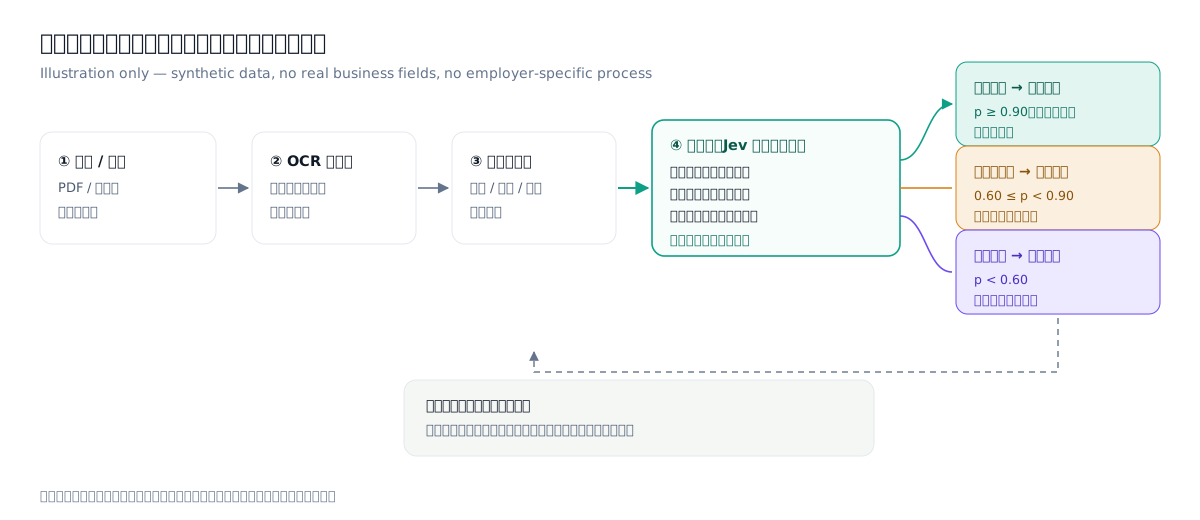
这类场景的运营指标其实是两条线:自动执行覆盖率与错误率。阈值往下调,覆盖率上升、错误率也上升,同时人工复核量下降;往上调则相反。这本质上和风控里「覆盖率 vs 精度」的取舍是同一件事——所以真正要调的不是模型,是这条曲线上的取点。 Operating this kind of pipeline really means managing two curves: coverage of automatic execution and error rate. Lower the threshold and coverage rises along with errors while review volume falls; raise it and the reverse. It is the same trade-off as precision versus coverage in risk control — the thing you tune is the point on that curve, not the model.
阈值 0.9 到底意味着什么
设想每月 1,000 份材料进来,阈值设 0.9:假设约 70% 的个案概率超过阈值,就是 700 份自动落库、300 份进人工复核。如果"0.9"真的意味着九成正确,那么自动落库的那 700 份里约有 70 份是错的;若把阈值加到 0.95,可能只剩 400 份自动、约 20 份错,代价是人工量从 300 涨到 600。于是问题不再是"模型准不准",而变成一个纯粹的算术题:你更愿意承担 50 份错单,还是多花 300 次人工?这也解释了为什么校准如此关键——如果模型说 0.9 而实际只有 0.7 对,上面每一个数字都要重算。 Take 1,000 documents a month at a 0.9 threshold: if 70% clear it, 700 post automatically and 300 go to review. If 0.9 truly means 90% accurate, about 70 of those 700 are wrong. Raise it to 0.95 and perhaps 400 post automatically with 20 errors, at the cost of 600 reviews. The question stops being "is the model accurate" and becomes arithmetic: fifty wrong postings, or three hundred extra reviews? That is why calibration decides everything here.
09三者对比Three-way comparison
| 现有 LLMExisting LLM | 经典分类器Classical classifier | Jev(官方口径)Jev (vendor account) | |
|---|---|---|---|
| 优化目标Objective | 人类偏好 / 可验证奖励Human preference / verifiable reward | 训练集上的损失最小化Loss minimisation on training data | 校准决策(RLCD)Calibrated decisions (RLCD) |
| 输出Output | 字符串,需解析校验Strings; parse and validate | 标签(+ 未校准分数)Label (+ uncalibrated score) | 类型化值 + 校准概率Typed value + calibrated probability |
| 采样Sampling | 串行,逐 tokenSequential, token by token | 一次前向One forward pass | 一次查询并行产生全部输出All outputs in one query |
| 延迟Latency | 3 – 329 s | 微秒 – 毫秒µs – ms | 70 – 500 ms |
| 输入成本Input cost | $0.20 – 10 / MTok | ≈ 0(本地)≈ 0 (local) | $0.042 / MTok |
| 概率可信度Trust in the probability | 过度自信且不一致Overconfident, inconsistent | 需另行校准Needs separate calibration | 校准为训练目标Calibration is the training target |
| 类型错误Type errors | 会发生,需容错Happen; needs handling | 不会(闭集)No (closed set) | 官方称不可能发生Vendor: impossible by construction |
| 适合Fits | 对话、写作、代码、开放问题Chat, writing, code, open problems | 标签空间小而稳定的任务Small, stable label spaces | 人工在环的流程、实时判断、大批量打分Human-in-the-loop flows, real-time decisions, bulk scoring |
| 不适合Does not fit | 需要确定性与延迟保证的链路Anything needing determinism and latency guarantees | 规则边界模糊、语义复杂的判断Fuzzy, semantically complex judgements | 需要自由文本或长链推理的任务Free-text generation or long reasoning chains |
注:第三列除延迟与成本外均为官方自述;官方同时承认类型错误的 0% 来自「schema matching is guaranteed」的机制保证,而非实测统计。[1][2] Note: column 3 is the vendor's own account; the vendor also notes the 0% type-error figure follows from a structural guarantee ("schema matching is guaranteed") rather than a measurement.[1][2]
10局限与反方观点Limits and the case against
这一节我尽量站到对面去写。目前关于 Jev 的全部公开信息都来自一家公司自己的叙述,而官方在同一篇里已经把该被质疑的地方标了出来——这点值得肯定,但也不能因此免除验证义务。 I have tried to argue the other side here. All public information on Jev comes from the company itself, and to its credit the vendor flags where scepticism is due — which does not remove the need to verify.
- 评测口径由卖方定义。官方承认:评测 workflow 由其模型能力团队构造,可能存在偏差;参考答案取 GPT-6 Astra 与 Fable 5.1 的平均,偏向 OpenAI 与 Anthropic,官方估计这反而低估了自家表现;LLM 一侧的数字来自 OpenRouter,复杂查询可能被路由到更强的模型。[1] The vendor defines the yardstick. The vendor acknowledges the workflows were built by its own capability team; the reference answer is the average of GPT-6 Astra and Fable 5.1, biased toward OpenAI and Anthropic (which the vendor says understates its own results); and the LLM-side numbers come from OpenRouter, where complex queries may be routed to stronger models.[1]
- 「零幻觉、零类型错误」是机制推论,不是独立实测。官方明说那一项数字不是经验值。机制上说得通(不生成自由文本,就不存在越界生成),但它衡量的是失败模式的空间,不等于准确率。[1] "Zero hallucination, zero type errors" is a structural argument, not an independent measurement. The vendor states the figure is not empirical. The mechanism is plausible — no free text means nothing to go out of range — but it bounds a failure mode rather than establishing accuracy.[1]
- 价格可持续性未经验证。官方自己写了「我们无法证明它没有补贴」;早期访问阶段的价格未必是长期价格。[1] Price sustainability is unproven. The vendor writes that it cannot prove the pricing is not subsidised; early-access pricing need not be long-term pricing.[1]
- 服务与合规细节未知。官方提到评测多数在西海岸的笔记本上跑(服务当前所在区域);训练数据来源、是否用于训练、私有部署、数据留存都未在这两篇材料里说明。[1] Service and compliance details are unknown. The vendor notes evals were mostly run from laptops on the West Coast, where the service currently sits. Training data provenance, opt-out, on-premise deployment and retention are not covered in these two pieces.[1]
- 能力边界仍然模糊。官方 FAQ 自己列了六个待展开的问题:为什么需要新的训练算法、适合哪些用例、它是否只是个更小的 LLM、公开基准表现如何、训练数据从哪来、结果为何可能。 Capability boundaries remain open. The vendor's own FAQ lists six questions it has not yet answered: why a new training algorithm was needed, which use cases fit, whether it is just a smaller LLM, how it performs on public benchmarks, where the training data comes from, and how the results are possible.[1]
我目前没有 early access,因此以下都还没做过:① 用同一批数据把「提示词 + JSON」与「决策层」跑成对照;② 用可靠性曲线检查它声称的概率是否真的校准;③ 在长尾样本(版式异常、字段缺失)上看概率是否随难度下降;④ 记录 p50/p95 延迟而不是平均值。做完会写进「实测复现」那一篇。 I have no early access, so none of the following has been done yet: (1) a like-for-like comparison of prompt-plus-JSON against a decision layer on one dataset; (2) a reliability diagram to test whether the claimed probabilities are calibrated; (3) long-tail behaviour (odd layouts, missing fields) and whether confidence falls with difficulty; (4) p50/p95 latency instead of averages. Results will go into the benchmark note.
11我的判断My take
我认为 Jev 这类东西真正的意义不在「更准」,而在把不确定性变成可以写进代码的对象。过去两年我们一直在用「让模型更聪明」来解决可靠性问题,但可靠性其实是接口问题:如果输出没有概率、没有取值范围、没有审计记录,再聪明的模型也只能待在人的后面。 The real significance is not accuracy but turning uncertainty into something you can write code against. The last two years have tried to buy reliability with intelligence, but reliability is an interface problem: without probabilities, bounded outputs and an audit trail, even a brilliant model stays behind a human.
如果要判断这一类产品值不值得投入,我会先问三个问题:它会把我的哪一段人工流程变成机器流程(而不是「它能做什么」);错误代价 vs 复核成本 是否划算;概率是否真的校准(这一条决定了前两条能不能成立)。三个问题答不上任何一个,就先只做离线跑分,别接进生产链路。 To judge whether a product like this is worth adopting, I would ask three questions first: which human step does it actually turn into a machine step (not what it can do in general); does the cost of error beat the cost of review; and are the probabilities genuinely calibrated — the third determines whether the first two hold. If any of them has no answer, keep it in offline scoring and out of production.
最后一句保留意见:目前的证据强度还不足以支撑采购决策。它值得的是两周的试点,不是一份年度合同。 One reservation to end on: the evidence so far is not strong enough to support a purchasing decision. It earns a two-week pilot, not an annual contract.
12落地前该问的八个问题Eight questions before a pilot
如果要把这类服务接进内部流程,我整理了一份提问清单。每条都附上「为什么要问」,方便直接拿去开会问供应商。 If a service like this is to enter an internal pipeline, here is the list of questions I would bring to the vendor, each with the reason it matters.
- 校准怎么评估?用可靠性曲线还是单一数字?分箱方式与样本量是多少?——决定「概率能不能拿来设阈值」。[1] How is calibration evaluated? Reliability diagram or a single number; what binning and sample size? This decides whether the probability can carry a threshold.[1]
- 分布外会怎样?换一批版式、换一个业务线之后,置信度是否可靠地下降?——校准失效通常发生在换场景的时候,不在同分布内。 What happens out of distribution? Does confidence fall reliably when layouts or business lines change? Calibration usually breaks on a change of setting, not within one.
- 能不能拒答?有没有显式的「我不知道 / 弃权」输出,而不是被迫在给定标签里挑一个?——这决定低置信度个案能不能优雅退出。 Can it abstain? Is there an explicit "I don't know" output rather than being forced to pick a label? This determines whether low-confidence cases can exit gracefully.
- 输出选项上限多少?官方提到单次支持到 255,更高需两段式。[1]——直接决定一个大问题能不能一次问完。 What is the cardinality limit? The vendor reports up to 255 in one call with a two-stage scheme beyond that.[1] It decides whether a problem fits in one shot.
- 延迟分布如何?要 p50 / p95 / p99,不要平均值;并确认服务所在区域与你的用户之间的距离。[1] What is the latency distribution? Ask for p50 / p95 / p99 rather than an average, and confirm where the service sits relative to your users.[1]
- 我们的数据会被用于训练吗?能不能关闭、留存多久、能不能删除?——金融与保险场景里这一条通常先于性能讨论。 Is our data used for training? Can it be turned off, how long is it retained, can it be deleted? In finance and insurance this usually precedes any performance discussion.
- 能不能私有化 / 区域部署?如果监管不允许把数据发到外部服务,这一条直接决定可行性。 Is private or regional deployment possible? If regulation forbids sending data to an external service, this single answer decides feasibility.
- 版本与回滚怎么办?模型升级后概率会不会变?能不能固定版本、能不能 A/B 比较?——上线之后真正的风险是「同一个输入,行为悄悄变了」。 How do versions and rollbacks work? Do probabilities shift after an upgrade; can a version be pinned and A/B compared? The real risk in production is silent behavioural change on the same input.
13来源Sources
- Diogo Almeida. Introducing System One Models & Jev. TypeSafe AI Blog, 2026-09-15.
typesafe.ai/blog/introducing-system-one-models-and-jev
本文引用的定义、四代对照、评测方法与偏差说明、成本与延迟区间、命名来源(Kahneman / Jevons)、Doom 与 Wikiracing 演示、cardinality 上限均出自此文。 Definitions, the four-generation comparison, eval methodology and stated biases, cost and latency ranges, naming (Kahneman / Jevons), the Doom and Wikiracing demos and the cardinality limit all come from this post. - TypeSafe AI 官网首页,访问日期 2026-09-25。
typesafe.ai
193.6× faster / 444.6× cheaper 与 $42 per billion input tokens 的表述出自首页;官方在发布文中说明这组数字来自其挑选的 workflow 评测。 The 193.6x / 444.6x and $42 per billion input tokens statements come from the homepage; the launch post explains they derive from the vendor's chosen workflow evals. - Daniel Kahneman. Thinking, Fast and Slow. Farrar, Straus and Giroux, 2011.
「System 1 / System 2」命名的出处(官方 FAQ 指明灵感来源)。 Source of the System 1 / System 2 naming, which the vendor's FAQ cites as the inspiration. - Jevons paradox. Wikipedia.
en.wikipedia.org/wiki/Jevons_paradox
「效率提升反而增加总消耗」这一经济史背景(模型命名取自 William Stanley Jevons)。 Background on efficiency gains raising total consumption; the model is named after William Stanley Jevons.
14引用本文Cite this note
Aylon (2026). Jev 与 System One Models:把 AI 变成代码里的一个判断. Notes, v1.0. https://aayloo.github.io/notes/jev-system-one-models/
15分享版摘要Shareable summary
16更新日志Changelog
| 版本Version | 日期Date | 改动Change |
|---|---|---|
| v1.0 | 2026-09-25 | 初版。依据官方 2026-09-15 发布文与官网首页;本文无实测数据,待拿到访问权限后补「实测复现」一篇。 First version, based on the 2026-09-15 launch post and homepage. No first-party measurements yet; a benchmark note will follow once access is available. |